Showing posts with label Safety. Show all posts

Wednesday, October 18, 2023

DelDOT's Ignorance of AASHTO Bicycle Facility Guidance

The typical DelDOT "shared use" curb cut, in clear violation of AASHTO guidance

2012 AASHTO Guide for the Development of Bicycle Facilities (pdf)

5.3.5 Other Intersection Treatments: Curb Ramps and Aprons
The opening of a shared use path at the roadway should be at least the same width as the shared use path itself. If a curb ramp is provided, the ramp should be the full width of the path, not including any side flares if utilized. The approach should provide a smooth and accessible transition between the path and the roadway.
AASHTO No-No: Sidewalks as "Bikeways", signed as such

DelDOT's Pavement & Rehabilitation section routinely installs as little as 4' wide ramps and island cut-throughs on bi-directional shared-use pathway (SUP) facilities. According to AASHTO guidance, this practice relegates these facilities to sidewalks. Perhaps nobody even notices this, after all, "why build good bike facilities, when nobody rides because of the lack of good facilities?" ~Barry Childress (Chair, Baltimore Spokes).

According to unnamed experts in the field, DelDOT's ignorance of AASHTO makes them responsible in the advent of an accident or crash. Further, the installation of signs indicating these are bikeways, when in fact bicycle equity and safety is gravely compromised should be an embarrassment to the Department. It also indicates just how involved the various advocacy orgs (DE Bicycle Council, DE Greenways, Bike DE, etc) are in "connecting everyone with a bicycle-friendly transportation network".

All of the $44M in RAISE funds granted to DE are going into two high profile projects that will fix none of the problems with Delaware's current bicycling infrastructure. Most of what we see now is in a state of disconnect and ruin, and will stay that way thanks to the above parties. Instead of developing design guidance for SUP width and alignment through stroad intersections, for example, and turning the countless "goat paths" in New Castle County into AASHTO-compliant pathways, every dollar goes to benefit a tiny minority.

The installation of grossly inadequate "multi-modal" infrastructure continues unabated in Delaware, and will guarantee that we remain a whopping ~0.02% bicycling modeshare. The State will continue as most dangerous in the U.S. for bicyclists and 2nd most deadly behind Florida. Oil-based transportation is the #1 source of AGW emissions, as our "leaders" in govt agencies and non-profits (most of whom never actually bike, or even walk apparently) make the decisions that seal this fate. Shame on all of them.

10' wide is reduced to 5' on the Linden Hill shared use pathway at Skyline Drive in Pike Creek

Wednesday, September 6, 2023

The Safety Of Cycling On Salem Church Road

Big shout out to BFF Productions for making this possible!

This video is a collaboration of Frank Warnock of 1st State Bikes and Mario Nappa. With Mario hosting, Frank Warnock answers questions about the hazards of riding on a 1/2-mile stretch of Salem Church Road between the I95 overpass on the north end to Old Baltimore Pike on the southern end.

At the end of the video we give you contact information so you can connect with your state representative to encourage that bike lanes are added along this section for the safety of cyclists, pedestrians, and motorists.

Thank you for watching and for your help in making Bike Route One a safer place to ride.

Friday, April 7, 2023

One Dozen Safety Suggestions For Wilmapco and NCC

WILMAPCO is appealing for feedback to reverse the "1st" that Delaware asked for over many decades time with poor land-use and infrastructure planning. Kudos to them for making this big step. But if our State is really serious about reducing injuries and fatals, it is going to take more than infra improvements on gov-owned roads and other public rights of way (ROW). In no particular order, here is our top 12 recommendations that SSFA (Safe Streets for All) must consider and implement to be effective:

  1. Reform the vehicle code for pedestrians. DE's code now ranks among the most inadequate and dangerous in the country. Bike Delaware fought and defeated past attempts at bringing said code in line (pdf) with other truly progressive States.
  2. Typical goat path from SR4 in S. Newark
    A holistic approach to infra that includes non-state lands and properties, e.g. abaondoned roads, "goat paths" and/or other potential buy or easement possibilities. These make critical connections e.g. Cavaliers to Christiana Mall, yet are actually discouraged! Shared-use pathways are paved parallel to shopping centers or strip commerce, but the only "connections" are goat paths traversing high curbs or over high fences. Ditto with neighborhoods and other vital destinations. This is grossly unacceptable and any safety campaign must address this issue. That said, the NCC "Safe Streets for All" interactive mapping tool is a great start; please participate.
  3. "20 is Plenty" (or similar) for neighborhoods and side streets, including replacement of all 25
    mph speed limit signs (Sen John Walsh performed a cost analysis), accompanied by an awareness campaign. This has had demonstrable results elsewhere in western society (i.e. Europe).
  4. Restrict use of radial turns and slip lanes to high speed roads only; these should never be used on streets at human scale, which DelDOT continues to do. Roads should have limited access via frontal streets only; Streets require crossroads to be safe. There is a big difference.
  5. Lower speed limits on arterial roads that have frequent red lights, crosswalks, bike lanes, shopping centers, schools etc. SR4 (E. Chestnut Hill Rd) thru Ogletown-S.Newark is posted at 50 mph, which is recklessly dangerous. Average speeds approach 60 mph, even through intersections where the East Coast Greenway parallels a deaf-blind and elementary school according to one speed study. Eliminate the 85th Percentile as exclusive guidance when setting speed limits.
  6. Carth Vader
  7. Robust laws aimed at curbing drag racing and aftermarket and modified exhaust systems. Such vehicle terrorism discourages anyone from venturing near DE's arterial roads and streets unless forced. And we all have connections that can only be made via arterial roads. Sen Walsh/Rep Williams already passed HB328 for the former, and HB35 is in process for the latter. PD and/or NCC follow-up to citizen complaints is key to enforcement. Kudos to the legislators involved.
  8. Redundant DMV driver training. Even a simple periodic quiz would help, perhaps with renewals. License and registration as a "right" has to end, replaced with the privilege to drive AND re-earning it from time to time.
  9. A gas tax to fund improvements across all vulnerable user types, given the unspeakable damage caused by people driving cars and burning fossil fuels vs non-motorists.
  10. Bike parking with ALL new commercial establishments (NCC), including refurbs -- not just ground-up construction. Find a way to incentivize existing services and establishments. Reform the land-use code in this manner.
  11. Stop using cement barriers and hanging cables instead of bollard(s) where bike/ped but not cars are permitted. This is lacking of common sense and results in tripping or crash hazards.
  12. Design, test and implement a Delaware MUTCD-specific Shared Zone signage, for use in mixed zones where speeding is notable. Examples include Creek Road north of Newark.
  13. Car-free and car-lite housing incentives at Delaware's schools, colleges and universities. This includes reducing student car parking and replacing it with car-sharing services instead.
Is there a #13 and beyond? Where is Bike Delaware and Delaware Greenways on any of these issues? Let us know in the comments section below if you have anything to add. Beyond that, this post marks the end of what we can do to help Delaware move forward in multi-modal safety and quality of life issues. Now on to populating the SSFA map.

Related: 
Where is Bike Delaware on these top 5 action items?

Tuesday, February 28, 2023

DelDOT: NO to Shared Zone signage on Creek Road

Creek Road on a recent winter's day
Sadly, DelDOT has denied Advocate's pleas for Shared Zone signage on Creek Road. Creek Road is a historic, narrow, 2-lane, unimproved rural route that extends from Newark through the White Clay Creek Valley. It is especially rich with pedestrian and bicycling activity just north of Newark, given University of Delaware's vast student population. It was abandoned for auto use starting about 0.8 miles south of Wedgewood Road, as much of the asphalt collapsed into the White Clay Creek, but enough width remains for dedicated trail use.

Creek Road is not actually a road; though rural, it qualifies as a Street and shared-use path (Pomeroy Trail) system. Upon our initial ask, Delaware State Parks eagerly embraced the idea and installed Shared Zone signs on DSP-managed roads open to automobiles. However, despite Creek Road having the highest mode-share by far, DelDOT wouldn't allow it. In a response from a DelDOT spokesperson:

DelDOT has implemented the low stress bikeway practices and designs. The Newark Bikeways signs was collaboration between Bike Newark, Wilmapco, Delaware Greenways, City of Newark and DelDOT. Traffic’s view is that this portion of Creek Rd is dedicated to highlight the low stress Newark Bikeway as far as signage is concerned. We don’t recommend any additional signage at this time. We can engage the City of Newark to see if they would like to include any in their limits along Creek Rd.

Traffic Studies also worked with Captain McDerby and Park Superintendent Lee with the posting of additional 25 mph speed limit signs. They stated it is a huge help with providing pedestrian, bike safety on this road for visitors entering White Clay Creek State Park.  

Sure, speed limit signs where before there were none helps. But DelDOT is citing the small, brown, relatively inconspicuous "Low Stress Bikeway" sign as adequate. We disagree, especially since bikes are the minority of  non-motorized users, and cars -- many speeding -- are expected to mix with majority walkers, hikers, runners etc.

Delaware is ranked the most dangerous State to bike in, and consistently ranks top 3 in pedestrian fatalities. As of March 1, 4 bicyclists have already been killed in Delaware. At this rate it'll be 24 for the year -- annihilating past (annual per-capita) totals of any State. To make matters worse, Delaware has no Statewide advocacy organization fighting in the interests of bike/ped safety.


If DelDOT is so mired in regulations that they cannot make this simple improvement, then they must develop, test and approve a similar custom sign for Delaware's MUTCD (traffic devices manual pdf). Advocates have offered to help, similar to the W11-1-DE project, but DelDOT has declined to answer.

When common sense is defied in such a manner, we cannot help but question the State's sincerity in terms of non-motorized encouragement and safety, climate mitigation and the greater good. Let's hope things change, and that DelDOT engineers and planners are given more autonomy to create safe streets environments.

Shared Zone implemented throughout White Clay Creek State Park -- except on Creek Road where it's needed most.

Tuesday, March 29, 2022

Safety Fail: Lack of Zebra Crossings on ECG in Ogletown

Seriously eroded ECG used for car parking
Cross-posted from Ogletown Resilience

With the approval of a Historical Marker commemorating Ogletown, and a quarter millennia  since the passing of its founder, the time has come to improve multi-modal access to this historic site. Regional legislators, including Senator Jack Walsh, have already agreed on action to address the failed infrastructure surrounding Thomas Ogle's tomb and green space. This includes the East Coast Greenway (ECG) west from SR273, and two connectors: one to Prides Crossing and the other to Chestnut Hill Estates via Old Ogletown Rd.

More recently, we discovered the gross lack of zebra striping of the ECG (streetview) through Chestnut Hill Plaza, a Meineke repair shop, and a Liberty gas station. Meinekie has even adopted the ROW as defacto car parking. This facility was originally paved at the width (8') required for bidirectional bike-ped traffic, and is eroded and narrowing in many sections. It rises up and back down through driveways, when the opposite is required for traffic calming and multi-modal awareness. Adding zebra crossings won't fix the problem of high speed entrances from SR4, but will bring awareness (and thus some added safety) for ECG users and Ogletown destination-making.

ECG just west of Augusta Drive
We were rebuffed in an effort to improve the Augusta Drive intersection further west. Instead, ECG continuity was broken, with a new, cars-only signal upgrade. Further west, driveways at the DE School for the Deaf (DSD) are properly aligned and zebra striped, as seen in the photo right. It would appear that Complete Streets is being applied sporadically, or by socio-economic status, with consequences that could take decades to fix.

The long range goal for the ECG is a continuous facility brought up to modern design standards, some of which can be found further to the east. Recent setbacks like Augusta, however, only cement Ogletown among the disenfranchised. When asked, there are few to no answers from several oversight orgs. In contrast, Advocates should be pouncing on each and every opportunity to improve the ECG -- even with basic highway maintenance projects as called for in DelDOT's Complete Streets policy.


This proposal
to enhance placemaking in Ogletown would bring some consolation -- not just for Thomas Ogle but also the loss of the Orphanage Property as a regional park -- the chance of which will never come again.

Thursday, March 3, 2022

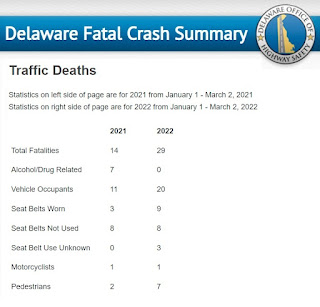
Delaware on track to smash 2021 crash fatals

First 2 months of 2022. Multi-year sampling periods confirm the
trend we are on. Click on image above for the latest numbers.
Statistically, Delaware is heading for a road safety disaster in 2022 - in particular New Castle County. Speeding, aggressive and distracted driving is rampant, with per-capita injuries and fatalities on pace to surpass even Florida. Despite strict laws to the contrary, many (if not most) offenders have a State-approved aftermarket and/or modified exhaust system. These behaviors account for why virtually nobody rides a bicycle for transportation or recreation -- even after 10 years of Complete Streets policy implementations.

There is virtually no pro-active law enforcement, particularly within Delaware's vast unincorporated zones. Police are few and far between, and spend most of their time answering 911 calls. An active and growing minority of drivers know this, as evidenced by the many vehicles now sporting fully tinted windows (also illegal). Even the City of Newark won't enforce the most deafening and disturbing of "loud mufflers". The lack of such basic government services has Delaware ranking criminally awful (CFPI), especially in matters of transparency. It is a top-5 worst State to live on several key socio-economic fronts, and consistently ranks as most dangerous to walk or ride a bicycle .

Mean Streets: designing cars like Dearth Vader
Our safety and quality of life is being destroyed right in front of our eyes; vehicle assault and violence is deafening our ears and ruining our health. County and State legislators offer token support, sometimes introducing bills that build on existing laws -- but these come up woefully short on enforcement. Organizations that claim to advocate for bicycling and connectivity have either given up on road safety or appear to be co-opted.

Minus a paradigm shift, and a mass conscience re-awakening toward the common good, things are only going to get worse. The suburbs, which comprises the vast majority of Delaware's built environment, are "entropy made visible", and will not be rescued unless we collectively change our thinking.

The above assaults are becoming more and more prevalent, even on Delaware's "quieter" neighborhood streets. We are trying to obtain 911 call data, that shows that this is among the most frequent emergency call types in New Castle County (stay tuned).


Above: "Bike Lane" on Red Mill Road in Ogletown. Authorities often question as to why so few people ride in Delaware, yet the answer is laid in rubber for all to see.

Wednesday, January 26, 2022

DelDOT: W11-1-DE Signs Restored on Paper Mill Rd

The W11-1-DE signs were removed from Paper Mill Rd at the White Clay Creek road bridge in Newark, upon the installation of a new pedestrian bridge. This sent the wrong message to car drivers that bicyclists are required to use this new bridge to circumvent the road bridge. We requested that the W11-1-DE signs be re-installed since bicyclists are legally permitted and will continue to use the road and its bike lanes. Failure to do so will result in drivers harassing bicyclists, given the new bridge is in plain sight.

Image courtesy of the Public Workshop
While this new bridge is a valuable amenity, the apparent switch to mandatory-use for bicyclists is problematic for 2 reasons:
  • It requires two crossings of 2 lanes of high VMT traffic in the northbound direction of Paper Mill Rd, which is statistically more dangerous, and more time consuming, and
  • Much of the pathway between the new bridge and Curtis Mill Park is 5' wide and not the min. 8' required to be safe. Therefore, it does not qualify as a bi-directional facility (this alone makes it ped-only) according to DelDOT's manual (pdf)

In this current config, the new bridge and its connecting pathways and crosswalks are not a suitable replacement for experienced bicyclists. DelDOT immediately responded, and re-installed the W11-1-DE signs on Mon Jan 24, and for that we are grateful.

Given how many people (esp students) ride the sidewalk now, it would certainly help if there was the required 8' asphalt SUP connected from the Old Paper Mill Rd crosswalk to the Pomeroy Trail. Regardless, we should never remove bicycling safety infra (in this case signage and sharrows) from the road. You can still see the signs in Streetview HERE.

Original W11-1-DE sign at Paper Mill Rd bridge southbound
With us backing him, Mark Luszcz (DelDOT Chief Traffic P.E. at the time) did a lot of work to get these signs approved and out there. This resulted in the removal of hundreds of "Share the Road" signs, replacing a mere fraction with W11-1-DE in strategic locations. This includes pinch points like the Paper Mill Rd road bridge. It was a big contribution in the reduction of sign clutter. It was also -- tho' not officially -- a compromise with P.E.s who don't like "Bicycles May Use Full Lane", because that sign (R4-11) preceded this one at this bridge and it was switched out unannounced.

Even if there is a project someday to connect 8' of asphalt between the Curtis Mill Park and the Pomeroy Trail, there are still bike lanes on Paper Mill Rd, so the signs should remain -- now more than ever actually. Kudos to DelDOT for listening, and answering the call of safety.

Friday, August 6, 2021

Our comments on the White Clay Creek State Park Master Plan

Greetings, DE State Parks. Please add our comments below to the White Clay Creek State Park Master Plan, before the 8-2-2021 deadline. Thank you very much.

In no particular order:

  • There is only 1 park bench/rest stop along the paved Tri-Valley SUP (Shared Use Pthway). There needs to be more, at equal distances, so people can stop, rest and take in the views. The same goes for the entire length of the Pomeroy and Creek Road Trails; there are no benches between Cleveland Ave in Newark all the way to PA, including at the various parking areas.
  • "Shared Zone" (or similar, MUTCD) and posted speed limit signs need to be added along Creek Road from N. College Ave to Wedgewood Roads. This is a human-scale environment shared with motor vehicles. See attached image (right). Presently there is no signage, and cars -- often times speeding -- are weaving between bike-ped traffic.
  • We do NOT agree with the others who are against using stone dust, fine gravel or limestone or other packing materials on trails. Please continue to use these as a proven means to control erosion and formalize trails as needed.
  • Please REMOVE the hanging cable that is blocking Tom Sharpe Lane, at Judge Morris Estate, turning in from Polly Drummond Road. This is a trip or crash hazard, and should be replaced with a removable bollard(s) or partial gate with clear bike-ped access, e.g. along Creek Rd.
  • Tell DelDOT to replace the unsightly concrete barriers on Creek Road at the Pomeroy Trail bridge curve with something more aesthetically pleasing. These are an eyesore and detract from the park's otherwise beautiful scenery.
  • With the advent of "Gravel" bikes and wider trail riding, park trails and pathways should be sub-grouped into the following categories, and mapped as such, e.g. 1. PAVED  2. GRAVEL  3. MTB
  • The Tri-Valley SUP is very overgrown between 9 foot Rd and its southern terminus at Thompson Station/SR72, and is reduced to about 2/3 width. This is hazardous for bi-directional bike-ped traffic. Please perform maintenance, including mowing and edging. At 8', this is the min recommended width for such a facility according to FHWA.
  • Improve safety for the bike-ped crossing between Creek Rd (gravel section) and Tweeds Mill (nature center). A large-sized MUTCD-approved R1-5 in each direction would be a big improvement. As it stands now, most motorists continue through the marked crosswalk, even with people standing there waiting.
  • Connect via SUP the Carpenter Area with the Pomeroy Trail, and that with the Possum Hill and Middle Run Areas.
  • Continue working on a WCCSP-Fair Hill connection via SUP, if that is still being considered.
Thank you so much for listening. Please let us know if there is a way to track our comments, to verify whether or not they are being considered.

--Frank Warnock & Angela Connolly


Above: A hanging cable blocks the entrance to Judge Morris Estate at White Clay Creek State Park. Bollard(s) should always be used where foot & pedal traffic is permitted. Users -- especially the disabled -- should not have to lift their bikes, step over, or cycle around a lengthy stone wall to access the Estate.

Wednesday, August 4, 2021

U.S. News & World Report: Delaware #1 Deadliest For Bicycling

... but a new report by StreetLight identifies the most dangerous states for cyclists by fatalities per capita and miles traveled, accounting for states where biking is more commonplace. By this definition, Delaware is the most dangerous state, followed by South Carolina and Florida, which has the most fatalities per capita. On the other side of the list, Massachusetts, New York and Illinois were among the safest states for cyclists. [Full Article ...]

Though shocking, this comes as no surprise really. Despite all the goodwill, and what appear numerous efforts to shore up safety, Delaware's #1 level of service (LOS) priority is still motor vehicles. This includes uninterupted travel at highest possible speed, inducing more and more demand with endless widening of roads, and providing parking craters at the expense of commons and place-making. Combined with infrastructure, retail and civil services that are anything but inviting and safe, almost nobody bikes for transportation in Delaware -- and the few that do are often times in grave danger. To make matters worse, we have a State's advocacy org that is corrupt and has little appetite to do anything meaningful about it.

In Massachusetts, for example, bike-ped crossing enforcement is taken very seriously -- and the results show. With few exceptions, cars begin stopping immediately when bicyclists or pedestrians approach a crossing facility. This sign (right) is but one tool in their toolbox. Instead, however, Bike Delaware quashed any efforts to move in this direction which included updating the vehicle code. Better enforcement with fines of up to $200 go a long way toward increased safety and respect of bicyclists and pedestrians. This, in turn, results in fewer injuries and fatalities, and promotes a culture of awareness and responsibility.

Friday, April 16, 2021

Senator Jack Walsh's District 9 Pathways Disaster

The following letter (email) was sent to Senator Jack Walsh, Delaware District 9.

Greetings, Senator Walsh,

What is your plan for 2021, to repair and maintain what few asphalt pathways are in your region? These serve as vital connectors for foot/pedal traffic. As of right now, and last year, they are an unmitigated disaster. We have attached a few pics in this email that you should recognize, but there are plenty of others.

There is Bike Delaware, Delaware Greenways, DelDOT's Complete Streets, Gov Markel's Trails & Pathways initiative, Gov Minner's Livable DE, Safe Routes to School, etc etc we could go on and on. These pathways should be clearly defined, with min. 8' wide smooth asphalt.

Rep Baumbach is busy cutting ribbons on parks and pathways projects in his district all the time, in Newark. But yours -- like [Senator] Townsend's -- is like a 3rd world country, at best.

What are you going to do about it?   -- Frank Warnock & Angela Connolly


Above: An overgrown hedgerow and a 2" raised steel plate are the ultimate crash hazard along Wyoming Road. Yet this is routinely used as an extension of Newark's Hall Trail.

Above: Abandoned pathway along Wyoming Road in Newark. What was once wide and appealing for multi-modal use is avoided in favor of the road shoulder. 

Above: What remains of a pathway spur connector, between Prides Crossing and East Coast Greenway along SR4.

Above: Brookbend "Park". Viable parks, pathways and placemaking are virtually non-existent in Walsh's District 9, and (Senator) Townsend's District 11.

Above: Bike Path, aka East Coast Greenway, parallel to SR 4, also in Walsh's District 9. Walsh could ask DelDOT to rehab this facility, and others, perhaps attached to local road rehab projects.

Walsh's reply as of 4/14/2021: I had previously answered your question on one of these paths. It is located on private property and the Church is required to clean up the path. This is the first I am hearing about the other two paths. One path pictured is the county's responsibility, so I can reach out to Councilman Sheldon's office about that one. The other path is on Route 4 and I will contact DelDOT to get them to clean that up.

No, Walsh did not answer anything, not in writing. We can find nothing in writing, and requested that he forward any sent emails that may have been overlooked. "3rd World Country" as defining Walsh's District 9 (and Townsend's District 11) for pathways, parks and destination/place-making is 100% accurate. It may even be an understatement. Will he answer our inquiry above, with a serious action plan? That remains to be seen.

Wednesday, April 1, 2020

Senator Jack Walsh obtains quotes for "20 is Plenty" in Delaware

Dear Senator Walsh,

In researching problems of speeding on neighborhood streets, there are Cities and States around the country that have come up with non-infrastructural solutions that quantifiably reduce speed. These involve flexibility in lowering speed limits by 5 (via unique signage and/or a campaign), or more effectively enforcing existing ones with better or more pronounced signage. Please review the following two PDFs of bills that were passed in 2 States: Washington and Oregon.

It has become clear that "everyone wants speed bumps"; that is the immediate answer anytime when asked for at a meeting. If so, then we have a serious problem in DE with speeding in residential areas. If a vocal resident is one of the lucky ones, the State sets out to measure 85th percentile, then they may issue a warrant if it exceeds 5 mph. Apparently, these asks are frequent, and costs high for installing speed bumps. And many are rejected even if there is a demonstrable speeding problem as in the case of Medley Drive.

As your constituent, would you consider writing a bill, perhaps combining the best of the two above, gather some co-sponsors and bring it to the floor for a vote? It may be tabled, or not pass the first time, but after repeated attempts, it might. Then, DelDOT would be free to try other calming means, e.g. signage, that is far less expensive than speed bumps, and could save lots of money and asphalt. We will attach a couple examples of such signs.

As an annual top-5 most deadly State in the U.S. for walking, we ask that you (and/or your Colleague Rep Bentz) consider writing and introducing such a bill, and if you will not, please explain why. Here is some additional reading on the subject (here and here).

Thank you very much, and we look forward to your reply.

Frank Warnock & Angela Connolly
www.ogletownresilience.org
---

Senator Jack Walsh responds:

Good Afternoon Mr. Warnock,

Thanks again for sending us those bills. We have completed an initial review with DelDOT and received a relative cost estimate that would be necessary if we were to change the residential speed limit from 25 MPH to 20 MPH statewide. The estimate ranges from approximately $550,000 to $1.1M for the installation of 2 signs per development since we maintain 1,501 developments statewide. This type of effort would involve fabrication and installation of over 3,000 signs at a minimum. However, the estimate doesn’t account for:
  • Developments that have multiple access points or speed limit signs (some developments have as many as 4-5 access points, if not more).
  • Speed limit signs co-posted with radar speed signs within developments.
  • Roads within municipalities that are state or locally maintained, such as Wilmington, Newark, Dover, Rehoboth, Lewes, etc.
We have also discussed these bills with our colleagues, and we will continue to do so over the next few months. For the reasons listed above, however, we are not confident that we would be able to move legislation you proposed forward at this time.

However, we have asked for an estimate for a radar signs to be installed on Medley Dr. This will show drivers how fast they are going along with displaying the speed limit. We will review once receiving the estimate.

Have a nice day,

Jack J Walsh
State Senator 9th District
O: 302-744-4163
C: 302-660-6295

Editors note: Why isn't Bike Delaware working on this? Unfortunately, their record suggests they won't, given other priorities.

Monday, October 28, 2019

Bike-Ped Dead: 6 Solid Reasons For Delaware's Dismal Ranking

Even with a flashing beacon, motorists still have
the right of way to continue, at speed, through
DelDOT's crosswalks without penalty -- as long
as peds (and bikes) are side-lined and waiting.
This is a completely backwards approach.
Delaware is once again poised for a dismally high position -- if not taking the nation's top spot for walking fatalities again this year. Ditto for bicycling - in a runaway - but we will cover that in a future article. Here, in no particular order, we will examine what we believe are the top 6 reasons for why this is so and will likely never change:

1) Motor vehicle priority and right of way through crosswalks and intersections. Delaware gives motor vehicles priority and right of way through mid-block crosswalks and radial turns, and puts the onus on pedestrians to create his or her own opportunity to cross. This doesn't change even with DelDOT's flashing beacons installed at a few of them; peds are still sidelined, waiting to make the first move -- hoping cars will stop. In no way is this progressive or conducive to pedestrian safety.

The way it should be. With a little enforcement. Mass
sees far greater compliance using this simple sign than
DE will ever see using stick figures and beacons.
2) An antiquated traffic code for pedestrians. There are numerous discrepancies and problems that a complete overhaul of Delaware's vehicle code is LONG overdue. The language is so antiquated that it even includes a holiday as impacting where and how to enforce it, including "soliciting contributions shall not apply on the Saturday immediately prior to Father's Day". Advocates volunteered many hours of time and did an overhaul, presenting it in legislative bill form to Delaware's Pedestrian Council. Ultimately, the State's defacto walking advocacy org, Bike Delaware, infiltrated the Ped Council and quashed the effort.

Crosswalks through highway-speed kill zones.
3) Wide lanes, slip lanes, and unregulated radial turns that induce high speed and discourage defensive driving, even in known pedestrian hot spots. Instead of traditional crossroads, most of Delaware's suburban thoroughfares consist of radial turns to keep motor vehicles moving as quickly as possible through intersections. This seriously compromises pedestrian safety, since the beginning and end of the crosswalk is unregulated and never signalized. As they are induced to maintain speed, motorists seldom yield, and usually just barrel on through even when pedestrians are present. This is not at all conducive to pedestrian safety, and not only adds to the danger, it discourage walking in the first place.

Non-drivers will often create "goat paths", as
the State and its Counties will not seek out and
try and include these important connections
with area rehab & reconstruction projects.
4) Very few pathway facilities that make safe connections between existing communities, commerce, and civil services. Lack of connectivity in development codes, and an ignorance of livability concerns throughout most of Delaware's planning history have all but sealed the fate of its suburban dwellers. Bike Delaware at one time made mention that connectivity is their mission, which includes piecing together what few streets do connect to try and create low stress networks. But for the vast majority of disconnected and unincorporated suburbs, they have yet to demonstrate how interconnecting pathways can be added without violating private property rights and/or invoking imminent domain -- never mind the exorbitant costs involved. In the end, those walking and biking are inevitably forced out onto arterial roads and their high speed intersections to reach most destinations.

5) An apparently fraudulent "Advocacy" organization in Delaware that will not support reforms, including a bill proposal (see #2 above) to update the traffic code in the interest of safety. "Bike Delaware" lobbies for reforms with priority on new housing construction only, helping developers achieve density waivers. With the occasional bone thrown to seasoned cyclists, they can focus on builder's profits with advocacy for "TOD" (Transit Oriented Development) and have this slip by virtually unnoticed. They ignore even the simplest ideas for retrofitting the built environment and have no record of endorsing open space conservation and park opportunities. Virtually all of their efforts are focused on the more privileged areas of the State including Old New Castle, the home of their Exec Director himself. For the unincorporated and disenfranchised folks who lack open space, bike paths and/or regional park access from home, they have to settle for what's on offer. This includes the high speed arterial roads and highways discussed here, for pleasure activities such as biking, walking and jogging.

6) Very little police presence and law enforcement to begin with. It is no secret that the police in Delaware -- in particular State and County -- are either stretched way too thin or even working without a contract. In what's become a culture of "anything goes", progressive reforms that include, e.g. stronger crosswalk signage with actual fines posted will remain out of the question. Unless a rare sting, the police are never around to actually enforce it, except perhaps in court after an injury or fatality. It is not uncommon at all for residents in unincorporated areas to go weeks or months without seeing a squad car in their region. When everyone knows that they can stretch, bend or break even the most basic laws of civility and predictability, higher crash counts inevitably follow. While the actions of the pedestrian (or bicyclist) is always cited as contributing or not, a gross lack of defensive driving due to paltry driver education, no redundant education, and virtually no law enforcement is a far greater problem overall.

Summary: Though certainly not alone in this, Delaware's built environment is a microcosm of the death and carnage now accepted as "normal" in the U.S. -- normal by placing motor vehicle traffic at human scale. Earlier govt planners, engineers and architects foisted this upon us by trashing livability in favor of "Stroads" that incorporate driveways, streets, parking lots, etc as directly connected to highways. Post WW2 design should have included frontage, service, and ring roads, and other treatments that allow highways to stay just that: relatively uninterrupted carriage ways between larger destinations with ample walking-biking cross-through (tunnel under) opportunities. Now dangerous by design, the State and its Counties (along with their Advisers and Advocates) are unable or unwilling to provide the needed tools and coping strategies.

View the proposed updated Delaware Vehicle Code for Pedestrians in pdf format, that was quashed by Bike Delaware and the Delaware Pedestrian Council with no further discussion. It was crafted by using the best of language from progressive States, e.g. Washington, Oregon, Mass, etc where motorist's respect for non-motorized road users is visibly higher than in Delaware, and the statistics are there to back it.

View the 2018 pedestrian fatality statistics for the whole of the U.S. Delaware took a "rest" from the top 5 in 2018, but is set to return in 2019.

Read an article in Strong Towns comparing Streets, Roads, and "Stroads", and what we can do to eliminate the latter in favor of livable streets and communities.

Watch James Howard Kunstler on YouTube destroy the very notion of cars as human scale.

Tuesday, October 8, 2019

Ogletown Road and the Folly of Bike Delaware

Forced to ride in the lane during sidewalk rehab activities on Ogletown Road, between the Newark Post Office
and Marrows Rd. The high speed lane or a 5' sidewalk will continue as the only options along this stretch. 

It's hard not to laugh when reading Bike Delaware's pages, adorned with slogans such as:

"Making cycling and walking safe, convenient, and fun in Delaware"


"OUR MISSION: Bike Delaware advocates for safe, convenient and fun cycling and walking for everyone"

"Bike Delaware’s organizational mission is to make cycling and walking safe, convenient and fun transportation options in Delaware"

"Our vision is bikeway networks that everyone can use to get where they want to go on a bike"

To anyone paying attention, it's only made "safe, convenient and fun" when it brings high profile attention to Bike Delaware, or if you happen to live in one of the State's few privileged locales or regions. Otherwise, you're SOL.

The photo at top was taken on Oct 5, 2019 on Ogletown Rd/SR273, between Marrows Rd and Library Ave in Newark. Bicyclists who are trying to access the Post Office are completely disenfranchised. The only access available to them is the high speed traffic lanes or a 5' sidewalk directly adjacent, with narrow twisting curb ramps. Access from behind the P.O., perhaps via College Square, is completely fenced off.

The Marrows Rd to Library Ave/SR72 phase of Newark's "Main Street Improvements" project is now underway. Ironic that nobody -- not even Wilmapco made a strong case (if any) that bicyclists cannot safely access this critical service, as well as other buildings along this stretch. But most ironic was the absence of Bike Delaware, that they didn't care to address this gross deficiency with DelDOT during the planning of this project or at any time before construction began. Here was a prime opportunity to include bicycle access in the form of, e.g. an 8' asphalt sidepath or shared use facility instead of the lane with cars or a narrow sidewalk. Yet they didn't even publicize the project notification for this critical aspect, never mind the project itself.. Wilmapco was content to leave it in their Newark Bicycle Plan as something for "future study". It will now be 15-20 more years before another rehab/reconstruction opportunity might present itself.

A recently repaved section of sidepath along Library Ave in Newark. At 6'
wide, it fails all known engineering criteria for a bi-directional bikeway facility,
and qualifies as just a sidewalk.
Of course, none of this comes as any surprise. Similar projects are going on all around Delaware that present clear opportunities for dedicated bike (and ped, shared) infrastructure, adjacent to or outside the lanes of traffic. Of crucial importance is when there is no shoulder or bike lane on a given road, and access can only be had by taking and controlling the lane of traffic -- often times at freeway speeds. Another example is SR72 in Newark and further south -- aka S. Chapel Street -- that many bicyclists use as a bike path connection between S. Newark, Bear, and points south. Advocates fought for 17 long years to upgrade the deteriorated 6' of asphalt sidepath to a more formal 8' shared use or "cycle track" facility. DelDOT finally agreed to "rehab" the existing facility using the same failed design standards used in the 1980s when it was first built.

Conclusion: For the disenfranchised and "unwashed" that populate the vastness of Delaware's suburban landscape, you'll be hard pressed to find anything positive going on for bicycling and pedestrian advocacy. Bike Delaware appears a fraud, a fake organization that pretends to care about bike-ped safety for all of us, but whose real mission it is to fast track high density development projects and profits to their corporate masters. This comes at the expense of key infrastructure safety and improvements in the built environment, never mind the loss of our last remaining wildlife, forests, fields, wetlands, and parkland opportunities. Bike Delaware does little or nothing at all to bring attention to individual DelDOT projects and workshops -- even when absolutely critical and presenting a one time-ever opportunity for making key connections. They are a virtual no-show in person and on their website when it comes to -- at the very least -- rallying Delaware bicyclists to the very projects that could possibly make their bicycling "safer" and more "convenient".

Friday, September 29, 2017

2018 Pave & Rehab list available for comment

As always, we continue to monitor Rave & Rehab projects for opportunities to improve multi-modal safety. Not long ago, we asked for and succeeded in getting bike pocket lanes on Elkton Rd (between Newark and the MD line) with an interim project. We continue to ask for shared right turn-only lane treatments on roads such as Route 72/Sunset Lake Rd south of Newark, and believe DelDOT will come through for us next time it is resurfaced. Each year, more and more opportunities arise, within the confines of what can be achieved with a basic Pave & Rehab project (beyond that, it becomes capital reconstruction) and re-striping. It is up to road safety advocates to take the lead on this, since Delaware's LAB sanctioned advocacy org has never once taken an interest.

According to Mark Luszcz, our Chief Traffic Engineer, DelDOT is closely aligned with the Federal Highway Department's recommendations as found in the manual Incorporating on-road bicycle facilities and safety treatments during repave/rehab projects. It is by far the most bang for the buck, as roads and shoulders are re-striped regardless. Combined with a Pave & Rehab project, it comes out much less expensive because a little added paint is the primary cost. On the other hand, bike paths cost vastly more to build and maintain. In an October 2013 article, we revealed the spending of nearly $2M to complete a 1/4 mile section of the Northern Delaware Greenway along Talley Road. A protected bike lane could have served a similar purpose at a small fraction of the cost.

As a bicyclist in the built environment, and follower of 1st State Bikes, you are invited to browse over DelDOT's list of upcoming (2018) Pave & Rehab projects. Please comment on any roads (or stretch of road or intersection) that you are familiar with, and could be safety enhanced. Send your input directly to DelDOT's Bicycle Coordinator at: John.Fiori@state.de.us


Visit the FHWA Program Page for full information