Showing posts with label Waste. Show all posts

Friday, August 11, 2017

Matthew Meyer, Felician Sisters Quash STOP Campaign

Clearing the property will start in the coming days or weeks
Save The Orphanage Property (STOP) officially ends campaign in defeat. Region's pedestrians, joggers, bicyclists, youngsters, etc come up empty. Glasgow, Pike Creek will remain nearest recreational park.

As of August 8, continued talks between New Castle County Executive Matthew Meyer and the Felician Sisters of North America broke down for the last time after failing to negotiate a few minor contractual terms. With a vote from the Sister's board of directors, a developer is now lined up to buy the land at barely over the appraised value ($5.9M) that was originally offered by Mr Meyer. They they will now go forward with the apartments, high density townhomes in the field space, and upscale houses replacing a large portion of woods and wetlands. Since the project plans are now fully completed, construction could begin at any moment.

As we look back on this tragic loss and gross injustice, a win for the disenfranchised residents of Ogletown-S. Newark just wasn’t in the cards. STOP advocates left no stone unturned, looking for any opportunity that would save this beautiful land and bring them a regional park. It was an exemplary citizen advocacy campaign that stuck to the facts, maintained decorum, and promoted full respect for our elected officials and the Nuns. Their core group included Donald Sharpe, who along with Dorothy Miller, helped save the White Clay Creek State Park. Also included was a NCC Tax Ditch Manager, an experienced environmental scientist and grant writer (who tirelessly sought other public and private funding sources), and a few other hard working citizen advocates who lived in the area. More than enough government funds were identified, including $1.25M in the State's Bond Bill, and even more in NCC's Parks budget. Significant private donor funds, totaling $1M or more, were also identified, with more under discussion. Further, the Felician Sisters offered to allow payments over 5+ years. You just couldn't have found a better offer, which amounted to a half price bargain for NCC. Ten organizations and multitudes of residents supported the STOP campaign, including almost a thousand following on multi-media alone. STOP yard signs dotted the neighborhoods.

Save The Orphanage Property's last act as an organization will be a final press release, with the facts as we know them. We will try to explain what has happened, why it happened, and who the few are (or the one) that allowed this to happen. One thing we do know for certain; after a long two years of advocacy and many sleepless nights, STOP ended in a total collapse of government representation of its citizens. It is something that the people will never, ever forgive their elected officials (and much of the Catholic Church) for. The Chestnut Hill "Preserve" will forever serve as a daily reminder of government incompetence, indifference, lack of empathy, and profiteering en-mass. Like a huge monument it will forever stay, always there to remind us that ordinary and working class folks mean little or nothing to them. We are no longer part of a democracy that represents the majority, but rather, a tiny minority of wealthy elite.

Saturday, July 15, 2017

NCC Executive Meyer puts the brakes on STOP

Statement from the Save The Orphanage Property (STOP) Campaign:

We are very sorry to have to tell you that we have lost this epic battle. We have all but exhausted every avenue of approach in trying to bring Ogletown a regional park instead of a destructive and totally unnecessary high density housing development. What we have found is that, no matter how or what we try, it is virtually impossible to win the battle for responsible land use in NCC when government and land developers are thoroughly allied and entrenched. Our campaign to protect the landscape, that included the identification of funding (State and donor), is over after 2 long and exhaustive years. It is a great shame because the property owners and their attorney had indicated their desire to negotiate, and make a deal for parkland instead. This is a tragedy that should not have happened.

In this particular fight, we had a thoroughly proven and documented case for why a regional park would be the superior choice and of greatest benefit to the already underserved residents of Ogletown and S. Newark. There was a few million dollars in NCC park funds available in the budget thanks to former Executive Tom Gordon. Our Legislators put 1.25M in the Bond Bill. A conservancy org had pledged 3/4 million. The Open Space Council pledged a quarter million more. In an offer of generosity, the Felician Sisters had agreed to accept a multi-year buy-out plan from the county/state, meaning that future payments could simply be earmarked in future budgets. This was a one time only opportunity that will never come again. It was a dream offer for NCC, and when something means this much, they make it happen. Not this time, not for Ogletown. Now the dream is dead. With his refusal to budge one dollar above the 5.9 million offer that he made to the Felician Sisters, County Executive Matthew Meyer has condemned this community to the devastating consequences of this massive development project which we now know will take place. Sources told us that although Mr. Meyer did indeed make an offer, it was one that was unreasonable, and designed to fail. Matthew Meyer has decided the future of generations to come. History will remember this, and his legacy will not be one of honor. Remember this when you enter the voting booth upon his re-election.

Where there's a will, there's a way. Instead, County Executive Meyer has turned his back on us. He and NCC lack political will and have put builders and profits over their constituents, quality of life, and the planet. At the County Council Meeting that we attended on July 11, instead of communication, respect, and transparency, we witnessed episodes of hostility and resentment, along with accusations of shady dealing and underhandedness. And from the start of Executive Meyer's term, there were red flags. Ask yourselves how Joseph Setting, the very Developer who just won the Orphanage Property, landed a position as Chairman of Executive Meyer's Parks Transition Team. This was a clear conflict of interest and we may yet investigate how we can make a formal objection.

We at STOP chose to take the high ground during the last few weeks, choosing to trust that Mr. Meyer would do the right thing, and act in the best interests of this community. We refused to participate in demonstrations and protests because we felt that, if there was even a shred of hope left, we could not risk alienating the Felician Sisters by risking disrespect shown to them during a protest. We also were bound to the many organizations that honored us by supporting us, and wanted to conduct ourselves with dignity. We choose to do battle with the keyboard, which we feel is mightier than the sword.

One thing we have learned is the importance of community engagement. Although we are at this moment devastated by Executive Meyer's sabotage, our spirits are not crushed. Although we will soon disable this page, we hope that you will join us here, or at 1stStBikes.org, where we will continue to try a make a difference and connect with our community. Land Use advocacy has left a bitter taste in our mouths, but our concern for our community will continue.

In closing, we urge all of you to consider what has unfolded when entering the voting booth next time. Please, never forget. Please consider this fiasco when voting for candidates for County Council. There is nothing more we can say at this point, except thanks to all of you for your support. We want you to know that we did everything within our power to stop this development from happening. We regret that we did not succeed.


Wednesday, February 15, 2017

DelDOT May Revise Elkton Road Reconstruction Plan

In light of recent comments, DelDOT may scale back the Elkton Road reconstruction/expansion project by nearly 2/3 to reflect actual needs. This number is derived from a reduction in added lanes between Otts Chapel Road and Route 4/896 (Christina Parkway).

Courtesy of Heather Dunigan, Wilmapco
The revision would ensure that only one additional lane will be added on the NE-bound side, to serve as an extended right turn-only lane. The SW-bound direction would maintain two through lanes similar to the existing design as we see it.

Excerpts from the Project Manager:
Based on the analysis, the alternative that could provide an effective alternative to the recommendations from the Planning study is the third option, which maintains two westbound lanes and adds a third eastbound lane from Otts Chapel Road that would end at the Route 4 intersection. With this option, the widening would be reduced in scope, but most importantly not sacrifice the needed safety improvement from Otts Chapel Road to Route 4.

We also recognize the comments that these improvements may facilitate toll evasion. Please note any roadway improvements in this part of Newark could be viewed as facilitating toll evasion; however, we feel limiting any capacity improvements to east of the Otts Chapel Road intersection should further minimize this potential issue
.

We will post again on this project after a review of the updated drawings. We have also asked DelDOT to provide us the estimated cost savings over the original proposal. In the meantime, a tip of the helmet goes to Mark Tudor of DelDOT, for responding quickly and bringing our comments and concerns before the project team. Thanks so much, Mark!

Friday, January 20, 2017

DelDOT may spend millions to better accommodate I95 toll evasion

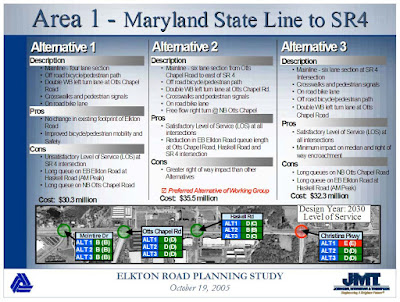
In 2005, the first public comments were gathered, and a DelDOT Working Group was assigned to select among three alternatives for the Elkton Road Reconstruction Project, Phase 2. They ultimately chose Alternative 2, the most invasive of the three, costing an additional $5M (in 2005 dollars). Among other "improvements", it includes double right turn-only lanes at Christina Parkway, and the lengthening of other dedicated turn lanes. Alternative 1, the least costly, came the closest to the original road footprint, maintaining 2 lanes in each direction.

For the record, we do not believe that bike/ped/quality of life advocates were fairly represented in this working group. All three alternatives do include a parallel pathway and bike lanes, and we are grateful for that. But we are unaware of any study data that might suggest how much of Elkton Road's current VMT (vehicle miles traveled) is the result of I95 toll evasion, and if Alternative 2 is justified.

We already know that our State Police officers are assigned to prosecuting commercial vehicles for toll evasion, using large black SUVs. It is a common sight to see, yet it is a foregone conclusion that probably most car and light truck drivers do the same to avoid paying the $4+ toll, especially if driving locally. For example, someone driving from Ogletown and points East will choose to stay on Route 4 to Elkton Road to get on I95, as opposed to using Route 896 and hitting the toll. For long haul or out of state travelers, there are even websites on how to easily circumvent.

Regardless of the toll problem, we simply can't solve congestion problems by turning our roads into a Route 13 and every intersection into a Hares Corner. Yet DelDOT is recommending a plan that will bring Elkton Road that much closer, with many more to come, and this will ultimately condemn us to 99% auto-dependency if they continue on this trajectory. Induced demand is another factor that DelDOT Planners and Engineers seriously need to consider when expanding roads and highways, but it is not clear how often they do. In the current mindset, the goal appears to be solving weight problems by adding more notches to the belt.

With this project, we may be about to spend millions of taxpayer dollars to better accommodate losing millions for our transportation coffers, which is a total travesty.

We will post further updates when we have them. In the interim, please direct your comments to Mark Tudor, Project Manager at dot-public-relations@state.de.us

http://deldot.gov/information/projects/CompletedProjects/elkton_road/pdfs/boards_workshop_10_19_05.pdf#search=Elkton%20Road%202005

http://deldot.gov/information/projects/ElktonRdMDLinetoCasho/pdfs/Workshop_Boards.pdf#search=Elkton%20Road

Friday, February 27, 2015

Induced Demand: Building new roads just makes people drive more


VOX -- For people who are constantly stuck in traffic jams, it seems like there should be an obvious solution - just widen the roads.

This makes intuitive sense. Building new lanes (or new highways entirely) adds capacity to road systems. And traffic, at its root, is a volume problem - there are too many cars trying to use not enough road.

But there's a fundamental problem with this idea. Decades of traffic data across the United States shows that adding new road capacity doesn't actually improve congestion. The latest example of this is the widening of Los Angeles' I-405 freeway, which was completed in May after five years of construction and a cost of over $1 billion. "The data shows that traffic is moving slightly slower now on 405 than before the widening," says Matthew Turner, a Brown University economist.

The main reason, Turner has found, is simple - adding road capacity spurs people to drive more miles, either by taking more trips by car or taking longer trips than they otherwise would have. He and University of Pennsylvania economist Gilles Duranton call this the "fundamental rule" of road congestion: adding road capacity just increases the total number of miles traveled by all vehicles.

This is because, for the most part, drivers aren't charged for using roads. So it's not surprising that a valuable resource, given away for free, leads people to use more of it. Economists see this phenomenon in a lot of places, and call it induced demand. [More ...]

Poster's note: Another great article on the subject here in "Wired" Magazine. We will always advocate for DelDOT to accept this reality. Instead of adding lane capacity, direct funding toward maintenance, rehabilitation, and the implementation of Complete Streets within our existing infrastructure. Anything more just induces demand and encourages suburban sprawl.

Tuesday, August 12, 2014

Why does DelDOT repave good, smooth roads?

A major concern among our followers is DelDOT's penchant for repaving roads that show few signs of wear or distress. Several examples have been noted over the past several years, including some where we collected before and after photos. Among the most recent is Harmony Road in Ogletown, currently being stripped (milled) of its surface, in preparation for fresh blacktop.

A wide angle view of the Harmony Road/Ruthar Drive intersection reveals little, if anything in the way of potholes, cracks, or uneven road surface. Area readers are at a loss to understand how or why this road needs repaving, but it is currently being done.

A closer look at the lanes on Harmony Road shows an excellent road surface. What few potholes or cracks there are could easily be patched, as opposed to repaving the entire road.

Old Ogletown Road, undergoing the milling (surface grinding) process a few years back. What appears to be a perfectly smooth surface was stripped and replaced.

Marrows Road in Newark also had its nice and smooth surface removed a few years ago, and replaced with fresh blacktop. In the photo above, the shoulders still remained - in perfect condition - but these too were milled and resurfaced shortly thereafter.

So why are they doing this? Removal and replacement of a road's surface is very costly, yet funding is supposed to be tight. Advocates are routinely told there is little money available for desperately needed projects like the Route 72 sidepath. And, not to mention, DelDOT's solvency is in question right now given a lack of reliable income.

So, we contacted DelDOT to inquire, and received this very thoughtful response:

In order to determine which roads will be worked on, a condition survey of every state-maintained road segment is performed every other year. This survey, which uses both computer based and visual measurements, that evaluates the condition of the roadway segment based on the severity and extent of pavement distresses such as cracking or rutting. The pavement management section prioritizes roadways using this condition data as well as other factors which include the amount of traffic on the road, the functional classification of the road, the facilities that are accessed from that road (employment centers, schools, fire houses, etc), and other circumstances that must be considered (project linkage, overall route continuity). A survey is performed by Pavement Management staff evaluating the roadway and a numerical value is assigned in each category.  We have a priority formula which uses these values to give each roadway segment a score. Road segments with a higher score are given higher priority. The highest scoring segments are reviewed in the field a second time by representatives throughout the department and a final treatment/plan for rehab is decided.

The Pavement and Rehabilitation program strives to maintain the condition of Delaware's roadways by systematically identifying candidates for rehabilitation and determining the most cost effective treatment. The program provides rehabilitation in the form of pavement preservation (patching, sealing, micro-surfacing, thinner overlays), replacement (mill and overlay), or reconstruction (cold in-place recycling, or full-depth reclamation). Because the cost of repairs increases disproportionately as the pavement condition worsens, it is important to balance rehabilitation work such that roads that may be in fair to good condition receive cost-effective preservation treatments, and poor condition roads are more substantially rehabilitated each year. The preservation treatments extend the life of the pavement, and result in not spending the annual budget on fixing only a few roads that are rated "poor".


To which I responded:

Thank you so much for the very thoughtful response. I have lived in several states, and traveled most others at some point, and can honestly say that I have never seen a system that pre-empts future deterioration and spending by replacing a good existing surface. It's usually moderate to severe deterioration and then act. North Jersey in particular is very bad, with roads rarely repaved until the surface is cratered throughout. Wheel alignment is all but a racket up there, yet property taxes are 5-7x higher than here in DE.
 

Even with your detailed explanation, it is still hard to wrap our heads around the removal and replacement of a smooth road surface. I have taken many pictures before and after, even the milling machine at one point on Old Ogletown Rd. As walking and bicycling advocates, we are routinely advised that funds are insufficient to include, i.e., the re-surfacing of parallel side paths as part of a road rehab project even when said paths are a safety hazard. This is our primary motivation for getting in touch on this issue.

Above: Sunset Lake Road/Route 72. Now here's a road that is far more in need of repaving than Harmony Road. Yet, DelDOT only recently installed rumble strips, which seems to indicate that the road is not on the schedule - at least for this year. Additionally, the rumble strips in the area of Reybold Road leave far less than the required shoulder width (4') to safely ride behind them. This issue was addressed and fixed in Sussex County, but so far it appears, not in New Castle County.
4 Seasons Parkway in Bear is also in desperate need. This road is an excellent bike lane candidate, with many key connections to schools and services. Again, much worse condition than Harmony Road.