Wednesday, March 29, 2017

John Allen: Suburban sprawl as it affects bicyclists

Easily one of the best studies you will find on the challenges that bicyclists and pedestrians face in the modern suburban environment. John Allen is one of the most thorough and distinguished advocates in the U.S., and mirrors virtually everything we struggle for at 1st State Bikes. Excerpts:

The large, low building in the top center of the picture is a school. Consider how your child would get to that school if you lived in one of the houses in the foreground. Your child would probably ride a school bus, provided at considerable expense to the community.

Photo by John S. Allen
The major impediment to use of the bicycle for transportation in sprawled suburbs is lack of connectivity. The school would be an easy bicycle ride away -- even an easy walk -- with a reasonably direct route (And there may be something approaching that in this example -- read on.). Much suburban residential development in the United States is like this, with only informal connectivity on dirt paths, if any.

Lack of connectivity reflects a lack of coordination between different developers, and a lack of vision and leadership by local government. This situation also reflects the preferences of residents to some degree, by keeping through motor traffic out of residential areas. But the baby has been thrown out with the bathwater, so to speak. A house you can see out your back window could be a mile or two away by road, or by any route that avoids trespassing on the private property of strangers.

Arterial streets may -- and should -- have wide outside lanes, shoulders or bike lanes to allow bicycles and motor vehicles to share them comfortably, and have traffic signals that work well for bicyclists. Bicyclists must ride on the arterial streets, or cross them, for some trips, especially, longer trips. But residents should not have to take a long trip around on the arterial streets to get to a neighbor's house they can see out their back window! 
[Cont . . .]

Most of Delaware's modern suburbs were planned as John describes, but you can still find a few older suburbs that were built with interconnectivity. These are usually before WWII until sometime in the 1970s, and closer to town centers and services.

High profile cases of child abduction (i.e. Etan Patz, Adam Walsh), and the unfounded notion that pathways can only facilitate crime also played its part. Hence, the situation we're in today that forces non-motorized users out onto arterial roads.

Fortunately, at least in New Castle County, the Unified Development Code has been updated and now calls for developments to include -- at minimum -- a pathway connection to existing communities. But with the County almost entirely built out, this amounts to a few drops in the bucket. Unless challenged, NIMBY sentiments will also reduce or even eliminate pathway and road connectivity altogether.

A pathway connection in Todd Estates, S. Newark, bridges two parallel streets so kids can safely walk or bike to school. It is a non-issue for these adjacent residents, because they bought their homes after the fact. Bike Delaware has made connectivity their mission, which includes piecing together such streets to create low stress networks. But they have yet to demonstrate how this can be accomplished without violating private property rights and/or invoking imminent domain -- never mind the high costs involved.

Wednesday, March 1, 2017

News Journal: Bring Ogletown Its First Regional Park

The concept of a regional park for Ogletown residents recently came under fire in the Wilmington News Journal, likely driven by developer interests. 1st State Bikes, partnered with STOP, responded with this letter. We're asking our followers to write their own letters too. Email: letters@delawareonline.com and include your name and full time phone number for verification.

Dear Editor, Wilmington News Journal:
In response to a recent letter about the Our Lady of Grace (aka Orphanage) property, nothing could be farther from the truth. It isn't so much about NIMBYs, but rather, the last chance for a walkable-bikeable regional park for Ogletown residents. And that's just one reason. Neighbors now are plagued with severe flooding and runoff issues that will be grossly hastened by paving over what is now vast permeable soils. For commuters, multiple intersections along Route 4 already fail level of service (LOS) requirements, according to DelDOT's Traffic Impact Study. Peak congestion is unbearable now, and this project would add thousands of more car trips per day.

A regional park, on the other hand, has enormous benefits. Studies conclude that those living within so many miles of parkland are healthier and are more likely to exercise, and this leads to lower healthcare costs. According to science, we are running out of time to halt climate change. We can't keep replacing carbon sinks with major sources of emissions, which defies the State's own greenhouse targets. And finally, the writer is wrong about jobs and tax rolls. Demand is flat because NCC is already saturated with tens of thousands of existing vacant homes. Any jobs that new housing creates will be very short lived, and at what cost? It's a fact that for every $1 in tax base that one household brings in, it costs about $1.25 in government and civil services to maintain that residence. That is why as urbanization increases, taxes follow suit. It's why DE residents pay a mere fraction of the taxes and cost of living expenses compared to our neighbors in NJ and NE PA, increasing steadily as you approach NYC. Is that what we want here?

Delaware has done a fair job preserving open space and farmlands, but most of it is not nearby or readily accessible for most of its residents. Minus a 20+ minute car ride, vast stretches of suburbia remain far away and disconnected. Ogletown is one of those places. We ask our Legislators and NCC Councilwoman to please bring a regional park to fruition.


Friday, February 17, 2017

Important: DelDOT Bicycle-Friendly Public Workshops

Don't forget to mark your calendar, and attend a DelDOT public workshop for bicycle-friendliness and safety in the First State!
  • 4–7 pm, Feb. 22, Sussex County Council Chambers (2 The Circle, Georgetown)
  • 4–7 pm, Feb. 27, Middletown HS Commons (120 Silver Lake Rd, Middletown)
  • 4:30–7:30 pm, Feb. 28, Dover Public Library (35 East Loockerman St, Dover)
  • 4–7 pm, March 1, Wilmington Public Library (10 East 10th St, Wilmington)
Balanced advocacy includes supporting on and off the road bicycle-specific infrastructure, as long as they are designed to best practices. Though we are seeing better quality as time goes by, it would be a serious mistake for advocates to assume equal level of service with vehicle drivers. Many are still being designed to relegate bicyclists to little more than wheeled pedestrians. Equal road rights and access cannot be ignored, because bicyclists will always depend on them for virtually every trip we make.

In any comments you make at these workshops, it is important to stress this fact. For example, a nearby bike path should never trump safety considerations on the roads they parallel. Failure here will lead to increased bullying from motorists, who see it as confirmation of "their" road given the nearby facility. In a worst case - as seen in some States now - the road itself may even go off limits to bicycling with mandatory use laws. Visit the workshop page HERE, and stand up for bicyclists as legitimate road users, facilities or no facilities. See you there!

Wednesday, February 15, 2017

DelDOT May Revise Elkton Road Reconstruction Plan

In light of recent comments, DelDOT may scale back the Elkton Road reconstruction/expansion project by nearly 2/3 to reflect actual needs. This number is derived from a reduction in added lanes between Otts Chapel Road and Route 4/896 (Christina Parkway).

Courtesy of Heather Dunigan, Wilmapco
The revision would ensure that only one additional lane will be added on the NE-bound side, to serve as an extended right turn-only lane. The SW-bound direction would maintain two through lanes similar to the existing design as we see it.

Excerpts from the Project Manager:
Based on the analysis, the alternative that could provide an effective alternative to the recommendations from the Planning study is the third option, which maintains two westbound lanes and adds a third eastbound lane from Otts Chapel Road that would end at the Route 4 intersection. With this option, the widening would be reduced in scope, but most importantly not sacrifice the needed safety improvement from Otts Chapel Road to Route 4.

We also recognize the comments that these improvements may facilitate toll evasion. Please note any roadway improvements in this part of Newark could be viewed as facilitating toll evasion; however, we feel limiting any capacity improvements to east of the Otts Chapel Road intersection should further minimize this potential issue
.

We will post again on this project after a review of the updated drawings. We have also asked DelDOT to provide us the estimated cost savings over the original proposal. In the meantime, a tip of the helmet goes to Mark Tudor of DelDOT, for responding quickly and bringing our comments and concerns before the project team. Thanks so much, Mark!

Friday, February 10, 2017

DPM: Delaware wants to lead the peloton of bike friendly states

Anthony Aglio
Delaware is currently the nation’s third most bike friendly state, according to the League of American Bicyclists. But state officials aren’t satisfied with that ranking. So Delaware’s Department of Transportation is hosting a series of public meetings in late February to find out how it can make the state even more bike friendly.   

The workshops will be opening listening sessions, according to Anthony Aglio, a bicycle planning manager for DelDOT. “We’re trying to pull people in to ask them why they aren’t bicycling, what do they like about bicycling, how can we make it better for them?” he said.

The state has also created an online survey to learn about people’s cycling priorities. “Is it safety, is it convenience, is it access to schools?” Aglio said.

DelDOT will use the input from the meetings and surveys to determine if they should be building more bike lanes, trails or safe routes to schools.

DelDOT will present a draft plan in another round of public meetings this fall. And then will use that input to craft a final plan to be released in early 2018. [Full article, including meeting details . . . ]

A lovely Sunday morning for Anthony Aglio, as he rides Route 9 en-route to Wilmington for the 2010 Delaware Bike Summit.  The Industrial Track Rail Trail, if completed, will (mostly) eliminate the need for non-motorized commuters to travel this normally congested, high speed corridor.

Thursday, February 2, 2017

Proposed Lidl in Ogletown eyed for active transportation accommodations

https://drive.google.com/open?id=0BzhSDH5rbIbdRjZTWU1oa3dQZEk
The Route 4 corridor through Ogletown has seen lots of changes over the last few decades. More recently, it was among the first chosen to receive retrofitted bike lanes/shared right turn-only lanes, helping increase safety for commuters.

In terms of land use, it was announced in September that Lidl, a German grocery chain, will be replacing Vince's Sports Center at the corner of Gender Road. The company appears committed to saving as much as 70% of the property (currently a 3-hole golf course) as open space, signing into agreement with neighboring residents. That would be an amazing goodwill gesture on the part of Lidl, given the pressure they now face with the proposed development of the Orphanage Property. In essence, it can be viewed as a re-development project that replaces an existing facility and preserves its green space.

Our Vince's-Lidl site survey has been on line for a few months, drawing 67 participants so far. The above 70% open space could be reduced to 50±% if residents get their wish for a coffee shop and/or outdoor cafe. Place-making is sorely needed in Ogletown, and many residents - even those that only drive - favor bike lane and pathway connections to nearby communities. Ange Connolly, co-admin of Save the Orphanage Property (STOP), serves on the Lidl Working Group, and presented the results in a meeting on Feb 1. In addition to place-making, she will be advocating for APBP-Standard bike parking and safe bike/ped pathway connections to Route 4 and its active transportation facilities.


As an aside, if we are to slowly but surely transform the built environment into something more bicycle and pedestrian friendly, we must have a voice in these projects early in the planning phase. And not just with new projects; advocates need to focus their energy and resources on retrofitting the suburbs. For active transportation commuters today, the construction of modern, transit-oriented developments (TODs) as an answer is way past its time. The built environment is already built, and most of our remaining open space - especially in New Castle County - is either environmentally critical or otherwise being hotly contested for parks and preservation needs.

Wednesday, February 1, 2017

Green Transportation Safety at the Glasgow Business Community

In the coming weeks, Mark Luszcz (Chief P.E, DelDOT), along with a DART Transit representative will be meeting with the Siemens Facilities Group and Dept of Environmental Health and Safety. The focus will be on bike/ped/transit improvements at the Route 896/GBC Drive intersection. Presentation below.

https://drive.google.com/open?id=0BzhSDH5rbIbdT2FIUGFSS0NrN28

The area has not been upgraded since highway construction in the mid-'90s. It was poorly designed, and left in a dangerous and undesirable condition for non-driving visitors to the Glasgow Business Community. Pedestrians are sometimes seen running across Route 896 on the north side of GBC Drive, because the existing crosswalk is on the non-building side and presents unnecessary challenges. Additionally, there are no pathway connections to and from the bus stop on the northbound side.


Further progress TBA.

Friday, January 20, 2017

DelDOT may spend millions to better accommodate I95 toll evasion

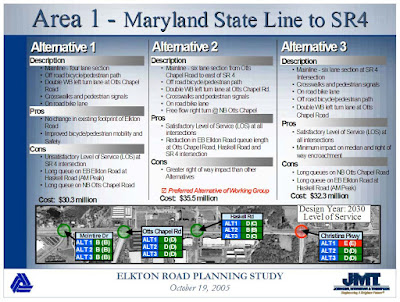
In 2005, the first public comments were gathered, and a DelDOT Working Group was assigned to select among three alternatives for the Elkton Road Reconstruction Project, Phase 2. They ultimately chose Alternative 2, the most invasive of the three, costing an additional $5M (in 2005 dollars). Among other "improvements", it includes double right turn-only lanes at Christina Parkway, and the lengthening of other dedicated turn lanes. Alternative 1, the least costly, came the closest to the original road footprint, maintaining 2 lanes in each direction.

For the record, we do not believe that bike/ped/quality of life advocates were fairly represented in this working group. All three alternatives do include a parallel pathway and bike lanes, and we are grateful for that. But we are unaware of any study data that might suggest how much of Elkton Road's current VMT (vehicle miles traveled) is the result of I95 toll evasion, and if Alternative 2 is justified.

We already know that our State Police officers are assigned to prosecuting commercial vehicles for toll evasion, using large black SUVs. It is a common sight to see, yet it is a foregone conclusion that probably most car and light truck drivers do the same to avoid paying the $4+ toll, especially if driving locally. For example, someone driving from Ogletown and points East will choose to stay on Route 4 to Elkton Road to get on I95, as opposed to using Route 896 and hitting the toll. For long haul or out of state travelers, there are even websites on how to easily circumvent.

Regardless of the toll problem, we simply can't solve congestion problems by turning our roads into a Route 13 and every intersection into a Hares Corner. Yet DelDOT is recommending a plan that will bring Elkton Road that much closer, with many more to come, and this will ultimately condemn us to 99% auto-dependency if they continue on this trajectory. Induced demand is another factor that DelDOT Planners and Engineers seriously need to consider when expanding roads and highways, but it is not clear how often they do. In the current mindset, the goal appears to be solving weight problems by adding more notches to the belt.

With this project, we may be about to spend millions of taxpayer dollars to better accommodate losing millions for our transportation coffers, which is a total travesty.

We will post further updates when we have them. In the interim, please direct your comments to Mark Tudor, Project Manager at dot-public-relations@state.de.us

http://deldot.gov/information/projects/CompletedProjects/elkton_road/pdfs/boards_workshop_10_19_05.pdf#search=Elkton%20Road%202005

http://deldot.gov/information/projects/ElktonRdMDLinetoCasho/pdfs/Workshop_Boards.pdf#search=Elkton%20Road

Thursday, January 19, 2017

Siemens Healthcare asks DelDOT to shore up commuter safety

For folks biking in the Ogletown-Glasgow area, Siemens Healthineers supports adding multi-modal safety provisions on key commuter routes. Several of their employees commute by bike, and the company recognizes the importance of reducing auto dependency.

The following letter was sent in March 2016, encouraging DelDOT to support bicycle safety and thus Green transportation alternatives. Siemens has also adopted Route 72 in the area of GBC Drive, performing annual litter patrols and cleanups. A big tip of the helmet goes to Jonathan Kroc and his Environmental Health and Safety Dept, for their wonderful stewardship on our behalf.


Note: Route 4 (Chestnut Hill Rd) has already been retrofitted with bike/shared lane treatments, and all of us hope that Route 72 (S. Chapel/Purgatory Swamp Rd) is scheduled for this year.

Wednesday, January 18, 2017

Ogletown Orphanage Property Trail Map

The Orphanage Property proposed park and trail system should be of interest to many of our readers. I mapped it by GPS last year when we first learned that it is threatened by an enormous mixed housing development. As many of you know, we are in the fight of our lives to save this beautiful landscape as a regional park for Ogletown - something that is desperately needed.

Residents in the eastern greater Newark area have been vastly underserved when it comes to parkland and open space. None of NCC's regional parks with amenities are within a safe walking or biking distance of their homes, while other surrounding areas including the City itself are continually adding them.

The easiest way to access the trail system is Pearson Drive, through Todd Estates II, south of Route 4. Pearson dead-ends at a major trail head with room for parking. Use caution; there is a small chance that you may encounter ATVs. The trails are mostly hard packed dirt, with occasional erosion and low spots that need restoration.

Please visit our facebook page dedicated to the cause, and consider liking us today!


Saturday, December 31, 2016

Unique opportunity to transform Newark's Main Street

Newark's Main Street is up for Pave & Rehab in 2017. Advocates have a historic opportunity to greatly improve bicycle safety and comfort downtown, if the City communicates to DelDOT their desire to participate in a national green lane experiment. DelDOT will not initiate this on their own; it will take the City, or the Newark Bicycle Committee, to spearhead the effort, with DelDOT in a supporting (and application) role. According to NACTO's website:

. . . in 2009, the city of Long Beach received FHWA and CTCDC approval to experiment with a shared lane marking that is set within a 5’ green painted area at the midpoint of the roadway in the left-most and right-most lanes.  A study conducted as part of the experiment measured a 100% increase in cyclists and an improvement in bicyclist lateral position in the roadway.

It is important that cities participate in these studies, in order for new infrastructure concepts to be adopted into National and State manuals as standard treatments. For example, in 2007, Ithaca NY was among several cities that participated in the use of Sharrows, and having them included in the 2009 MUTCD for the first time.

Newark is moving forward with "Parkettes". It goes without saying that designating Main Street's right lane (clearly marked) for mixed use would only increase safety. Sitting outside within the confines of a parking space, immediately adjacent to passing traffic will be a leap of faith for most people in the current environment. Though uncommon, parkettes have been struck by cars.

It should also be noted that for many years, Newark officials (most notably Mayor Vance Funk) declared that they had a vision for a Main Street bike lane, even if it came at the expense of one side of car parking. Instead, we have businesses and city planners scrambling to add a parking garage.

Though it has been strictly outlawed, most UD students and locals that bike Newark simply refuse to ride in Main Street's right lane in its current configuration (sharrows only). Aggressive and distracted driving are among the top reasons cited, and that's not about to change anytime soon.

Conclusion: Though there would need a push, and some initial work involved, Newark has a unique opportunity to improve bicycle and (future) parkette safety on Main Street. They would encourage more folks to ride in the right lane where they belong. Mode share for non-motorized traffic would increase. The City would be participating in a national process to have shared green lane infrastructure nationally approved. They would be making due on their long promised Main Street bike lane, though a shared lane compromise (but one we could all embrace). It would be a great shame if Newark did not pursue this idea, and chose to commit this upcoming Pave & Rehab project with only Sharrows to show for it, for the duration of its life, which could be 15 years or more.

Thursday, December 22, 2016

1st State Bikes followers demand update. We deliver.

Seasons Greetings, Delaware Street Bicyclists, and Happy New Year 2017!

In the face of popular demand, it has been decided that we should add a post that reflects our ongoing bicycling and pedestrian (and more recently, land use) advocacy in the Greater Newark area since early 2015. It's been a busy and productive time! Here are the projects that we at 1st State BIKES have taken active leads on, along with an update on their status.
  • The Shared Right Turn-Only (RTO) Lane treatment is finally approved and being implemented. First was Limestone Rd through Pike Creek, followed by Kirkwood Hwy between Red Mill Rd and Saint James Church. The most recent is Route 4 between Newark and Stanton. These improvements are by no means a panacea, but they do increase safety and comfort for riders today that have no choice but to ride on arterial roads. They tell motorists to expect bicyclists on the roadway, and encourage respect and safer positioning when overtaking on the approach to intersections. Upon the request of advocates, DelDOT has agreed to use the treatment during pavement & rehabilitation projects, but also agreed to "retrofit" one existing corridor (not in need of repave) per year. Route 4 above was for 2016. You can read past posts giving a history of the shared RTO treatment HERE.
  • The Multi-Use Pathway running parallel to Route 72 (S. Chapel St) south from Newark will, apparently, be repaved/reconstructed sometime in 2017. We only learned of this recently from the Newark Bicycle Committee's newsletter "Mailbag". Since 2003, rehab of this facility between Route 4 and Old Baltimore Pike was my personal priority, as evidenced by continuous postings in this blog. It began with DelDOT's Bicycle Coordinator Dave Petroski, followed by Joe Cantalupo, and lastly Anthony Aglio. For whatever reason, the last - despite many years working closely together - didn't see it fit to inform us, assuming it's true.
  • We were caught completely off guard with a lane expansion project on eastbound Route 4, just east of Harmony Road in Ogletown. To the chagrin of motorists, thru-moving bicyclists must control of the inside of two RTO lanes before picking up the shoulder again east of Samoset Dr. A well designed parallel MUP was also included in the project, but cannot be reached without leaving the street and changing to a pedestrian. We continue to ask DelDOT to apply Sharrows in the inside RTO lane, or provide easy on/easy off ramp access to the MUP immediately east of Harmony Rd (at the onset of the outside RTO lane). As it stands now, this approx two block stretch is a bicyclist's worst nightmare.
  • Based on a DelDOT working group's recommendation, they are planning to go ahead with lane expansion (3 lanes in each direction between Otts Chapel and Christina Pkwy) for the Elkton Rd Reconstruction Project, Phase 2. This, in addition to double RTO lanes at Christina Pkway. We do not believe that bike/ped/quality of life advocates were fairly represented in the group. The project does include a parallel MUP and bike lanes, but we are opposing the added 3rd lane. We simply can't solve congestion problems by turning every road into a Route 13 and every intersection into a Hares Corner. That is what our future could hold if DelDOT continues on its current trajectory. There is also induced demand, but most damning is the fact that a significant amount of Elkton Rd traffic is from motorists evading the I95 toll. Projected demand out to 2030 supposedly calls for the added lanes, but we have strongly urged DelDOT - with Wilmapco in CC - not to spend the additional $5M added cost until studies have been conducted. We already know that the police stake out the area, and routinely prosecute commercial vehicles for toll evasion.
  • Last year, Delaware was #1 in the nation for per-capita pedestrian fatalities, and to that end, an attempt is underway to reform Delaware's vehicle code. Known as the "Pedestrian Bill", it would be modeled after other progressive States such as WA, MA, OR, etc, bringing it up to date with modern times. As ours stands now, the language is almost totally car-centric, placing most of the onus on pedestrians not to get killed. It actually requires peds to be in the crosswalk before a yield is legally required, whereas other States only require intent to cross as a trigger. There are other issues as well, including an antiquated reference to Father's Day somehow influencing the law's enforcement. An upgrade here would be a monumental step in the right direction, and give pedestrians the confidence they need to use proper crosswalks where available. As members and constituents of the NCC Civic League, we will be looking to them for its first endorsement. A huge tip of the helmet goes to Amy Wilburn for spearheading this effort.
  • 1st State Bikes is working with the region's first Lidl grocery store (expected construction in 2018) to become the model for bike/ped/transit-friendliness. Angela Connolly proudly accepted a position in their Community Working Group as an active transportation advocate. Originally, the company had committed to maintaining 70% of the property (now a 3-hole golf course) as dedicated open space. That could drop to 50% if the company decides to include a coffee shop and/or bakery (think Panera) in tandem with the grocery store. But no less than 50% will be set aside regardless. Angela is working very hard to ensure that both have state of the art (apbp approved) bike parking, an outdoor cafe', and site pathways and other important features centered around community building and place-making. Do you live in the area? Have your say with this quick 5-question project survey. A tip of the helmet to Angela for taking this on, and pursuing only the best for current and future Ogletown residents!
  • We have repeatedly asked DelDOT to lower the speed limit on Route 4 through Ogletown. Currently, it is 50 mph, with many driving well in excess. Sympathetic to our cause, Senator Karen Peterson requested that a  speed study be conducted and the corridor be re-evaluated from a safety standpoint. It was found that the average speed was 53 mph. Considering the stop and go nature of Route 4, it takes many folks far exceeding the speed limit to create said average, and it shows. Unfortunately, to the average person, 3 mph over doesn't sound so bad. Unfortunately, despite several schools - including one for the deaf (where students can be seen walking the a adjacent pathway and crosswalks) - and multiple intersections and retail centers rich with bike/ped activity, DelDOT refuses to budge on this one - not even a drop to 45 mph. At issue is the "85th Percentile" , a method used to determine speed limits that is actually based on the assumption that most motorists are law abiding citizens (good drivers).
  • A major housing development is planned for one of the last remaining significant tracts open space in the greater Newark area. Comprised largely of forests and wetlands - including a few vernal pools - clearing and paving over these natural areas will have major repercussions for threatened and endangered wildlife species. It will also add to existing flood problems, and substantially increase traffic in neighborhood communities and on Route 4. This will have serious
    consequences for bike/ped/transit users as well. Our vision is for the State and New Castle County to buy most of the property and add it to the park system. To that end, we created the community Facebook page "Save Ogletown Pond", with nearly 800 genuine likes and dedicated followers. Progress is at a standstill for now, given the holidays, but we expect the good news to come sometime in early 2017 (we hope). A park here would be the region's first, possibly modeled after Glasgow Park with all its amenities (pathways, pavilions, courts, bike parking, etc).
  • November, two advocates from 1st State Bikes accepted positions on the Executive Board of the Coalition for Natural Stream Valleys. If you haven't already heard of this org, the CFNSV was the main advocacy force behind White Clay Creek SP, Middle Run Valley, the recently State acquired Deerfield Golf and Country club, etc. It consists of several legendary land use advocates, including Arabella Bianco, Richard DuPont and Donald Sharpe. The hope is to strengthen our alliances in the face of non-support from other bicycling-related orgs. We also see this as an opportunity to better position ourselves in the fight to Save Ogletown Pond (orphanage property). We already joined forces with the CFNSV back in April, in an unsuccessful attempt to have open space funding (originally legislated at $10M for farmland and $9M for open space) reinstated in the bond bill. We also worked hard to convince the Democratic Party to include open space as a plank in their campaign platform, and are still waiting for their decision. If led, please visit and like their Facebook page!
  • An opportunity to eliminate a dangerous crosswalk design with a pave & rehab project in Glasgow (across Route 896 at the jct of GBC Dr) appears to be lost. DART Bus Route 55 drops Siemens Healthcare transit commuters at a bus stop just north of the intersection. The existing crosswalk (to nowhere) crosses on the south side, and sees virtually no users because of the added time and steps involved. Rather than cross two legs of crosswalk and back again without one (3 legs total), commuters find it much simpler to run across 896 either from the bus stop or on the non-crosswalk side. Unfortunately, it wasn't until after the concrete was laid did we realize that no redesign was in the works. We informed both DelDOT and DART officials, and informed them of this rare opportunity to right a potentially deadly design flaw. DelDOT claims that they reached out to DART without a response, and DART claims no such actions were taken. It is not clear if DelDOT will consider moving the crosswalk to the north side - where it belongs - at this late stage of the rehab. We are still waiting for a formal decision one way or the other.
  • As always, we continue to monitor pave & rehab projects for opportunities to improve multi-modal safety. We asked for and won bike pocket lanes on Elkton Rd (between Newark and the MD line) with a recently completed interim repave project. We have asked for shared RTO treatments (first item above) on Route 72/Sunset Lake Rd south of Newark, and believe DelDOT will come through for us with a repaving next year. Each year, more and more opportunities arise, within the confines of what can be achieved with a basic pave & rehab project (beyond that, it becomes capital reconstruction) and re-striping. It is up to road safety advocates to take the lead on this, in the face of refusal by our State's LAB sanctioned advocacy org.
  • Finally, it is critically important that we monitor all car-bicycle crashes, and rally to the cause of bicycle safety. Only this way can we make the Vulnerable Road Users law an established penalty by the court, and draw attention to the price we all pay for reckless, aggressive, and or distracted driving. Sadly, again, our State's nationally sanctioned (and hugely popular) advocacy org had this to say regarding a high profile case in 2015: "We will announce the sentencing dates for [name withheld] but not actively promote "packing" the courtroom. Our position is that it's up to each cyclist to decide about the value of them personally attending".

    "Packing the Courtroom" is a strategy that has been used with much success elsewhere. Even a few cyclists helps, as it is unusual for people who did not know a victim to attend hearings or write impact statements; the more the better. Yet, though said org was the lone recipient of memorial funds, they went on to ignore an advocate's request to post the date of the sentencing and encourage attendance (they also refused to support the 3' passing law PR campaign, but that's another story). This is unacceptable. The first thought should be getting bicyclists to the courthouse that day, after having written even the simplest of impact statements beforehand. The following excerpt from Bicycling Magazine makes an excellent case. Excerpt:

    A lawyer named Oren Noah, one of the group's founding members, proposed a campaign similar to one that had been waged five years earlier in Marin County, after a rider named Cecily Krone—an occupational therapist who worked with handicapped children—was killed at 9:30 a.m. on a Sunday by a drunk driver searching for a cigarette. Cyclists packed county courtrooms at every hearing related to the case, and the driver was sentenced to six years in jail for vehicular manslaughter. Noah now suggested that Sonoma cyclists follow that example, not only to draw the attention of judges and the media, but also to show the perpetrators themselves "that they killed humans with friends and robbed from the community.... [and to] maintain the focus where it should be: on the drunk killers"


    That's all for now, folks. This article does not signify a return to regular blogging, however, occasional updates on the efforts listed above, or the addition of new ones may appear from time to time. And as always, we at 1st State BIKES will continue to advocate for safer facilities for all bicyclists and pedestrians, as well as advocating for land conservation/preservation and responsible land development where necessary.  -FW-

    Monday, March 30, 2015

    The Last Post (for now)

    1st State BIKES was started by the need for on-road safety and advocacy in Delaware, and to support the Delaware Bicycle Council. In doing so, it filled an obvious void left by Bike Delaware, the State's League of American Bicyclists supported bicycling advocacy organization. In nearly two years, 400 articles were written or cross-posted, that run the gamut of bicycle advocacy as described in the LAB's 5 Es. These included Engineering, Education, Encouragement, Enforcement, and Evaluation, mostly as they pertain to riding on our public roads. Missing from LAB's equation, however, is a 6th "E" that was somehow forgotten: Equality. As described by the American Bicyclist Education Association, it stands for the following:
    Equal Level of Service is a critical part
    of bicycle advocacy.
    • Uniformity: Ensuring uniform laws throughout a state to protect against access, movement, and equipment ordinances that discriminate against cyclists.
    • Access: Affirming the legal rights of bicyclists to use all highways, and all parts and features of those highways, particularly the roadway itself (i.e. the part designated for driving of vehicles, excluding shoulders, sidewalks, etc.), except possibly for controlled access freeways for which sound and reasonable alternatives are available.
    • Movement: Affirming that the default behavior for motorists, lane control on laned roadways, is also the default behavior for bicyclists. This means no bicyclist (class) specific movement rules that prohibit lane control or restrict turning movements or the use of turn lanes. Also unacceptable are any laws that prevent cyclists from making the same movements as other drivers or subject them to more restrictive lane usage rules than other drivers. This equal legal roadway movement status does not prevent or inhibit bicyclists from using special facilities, which serve as options for bicycle travel.
    • Equipment: Ensuring that minimum bike propulsion, fit, braking and lighting requirements are adequate for effective operation and precluding restrictions unrelated to safety or effective operation.
    Due to our high percentage of arterial roads, however, equality is not always safe, easy, or desirable. Geographically, only a small percentage of Delaware is truly urbanized or early 20th century suburban where bicycle driving (aka "vehicular cycling") can be effective. For those wishing to ride away from the road for transportation, very few rail trail or other right of way (row) possibilities exist. As a result, shoulder and bike lane riding with high speed traffic is very common here compared to many other States. It is for this reason that we have advocated for well designed infrastructure treatments that define a bicyclist's safest position on the roadway, especially leading up to and through intersections. We also worked with DelDOT to improve our warning signs for bicyclists, and offered to help with the targeted removal of generic (symbol only) signs over time. Known in the manuals as the W11-1, this sign is no longer applicable in most locations, since Bike Delaware campaigned to eliminate "Share the Road" from DelDOT's manuals based on a technicality. Another notable success was bicycle-friendly rumble strips - not only in Delaware, but in Maryland as well (though in recent applications, some important specs have been ignored, hence the need for continued advocacy).

    Jennifer Wallace stresses the importance of non-profit accountability
    during the 2015 Delaware Environmental Summit in Dover. Transparency
    is a foreign concept to some bicycling organizations in Delaware,
    including co-ops.
    With the LAB refusing to help our cause, having stated as much in writing, we have little choice but to accept the fact that separated infrastructure (sidepaths and off-alignment trails) is the first choice among Delaware's bicyclists. As a result, riding for transportation and recreation in the built environment - at least for those that appreciate leaving from home - will remain a huge uphill battle. Bicyclists are a virtual no-show for even the simplest of action items that could positively impact bicycle-friendliness in the 1st State. They seldom show up at DelDOT public workshops, or sign petitions regardless of how well publicized. Progress will be difficult, as long as Delaware's bicycling community - including its cooperatives and mountain bicyclists - refuse to unite in a single front that works together for its own common good.

    There needs to be one large tent that all of us can work under, as seen in other bicycle-friendly States. The approach needs to be holistic, and all-inclusive. Unfortunately, even Delaware's most committed road bicyclists are content to follow the lead of an organization with a very small tent - akin to a Chinese cocktail umbrella - that lobbies exclusively for separated facilities. In doing so, they are undermining the efforts of those that do advocate for on-road safety and infrastructure. Further, the State's recreational clubs continue with monetary support of said organization, despite the lack of an annual report, and the lowest level of transparency and accountability for a non-profit. No one even questions the acceptance of charitable donations collected on behalf of the Phillip Bishop tragedy, and why at least some of it wasn't allocated for PSA campaigns like this one.

    Here is a sampling of the issues, where said organization (Bike Delaware) has damaged the cause of road bicycling:
    • Absent on anything to do with the Vulnerable Road Users Law. Never supported the Delaware Bicycle Council on matters of legislation, i.e. Refused to "babysit" the 3' passing law by attending its hearing, and only agreed with it in principle.
    • Hijacked the LAB's Bicycle Friendly State's year to year rankings, providing instead what appeared a linear climb to the top for Delaware. Has everyone believing that our Top 5 ranking is based almost exclusively on pathway funding, when in fact it was also due to State legislation and policy changes/additions that address bicycle safety (the work of others).
    • Undermined a bus PSA banner that read "Same Roads, Same Rules, Same Rights", to where DelDOT replaced it with "Safety Begins With Sharing".
    • In a negative letter giving borderline support, the E.D. almost undermined AASHTO standard bike lanes on Rt.13 in Dover, which have since improved the safety of hundreds of commuters including migrant workers along the corridor.
    • Did not support a joint survey with RideShare Delaware, aimed at the users of the Rt.13 bike lanes, to find out whether or not they felt safer as a result.
    • Publicly stated that bike pocket lanes are "human meat grinders".
    • Despite initial support, and DelDOT's requesting it, the E.D. steadfastly maintained that SB-120 (a law to provide legal protections for bicyclists using a dedicated right turn-only lane as a continuation of a bike lane) wasn't necessary.
    • Pushed for the removal of our widespread (on most major roads) Share the Road signs, but did not support the efforts of others to redesign and replace them with something better (i.e. Bicycles "In Lane").
    • Has never once supported the application of Complete Streets during a Pave & Rehab project. Unfortunately, most often, these are the only chance we have at improvements.
    • Did not support an on-line petition for the enforcement of bicycle parking ordinances in New Castle County, given how often they are waived.
    • Did not support an on-line petition for the creation of an on-road Wilmington to Newark marked route, one that DelDOT would watch for enhanced safety improvements.
    • Never rallies attention to DelDOT public workshops unless it's for a separated facility or pathways project. It was the work of other advocates that drew attention to and won bicycle accommodations through Delaware's first "Diverging Diamond" Rt.1 overpass on Rt.72, coming next year.
    • Does little to memorialize bicycling fatalities, unless it benefits their agenda or bottom line. Did nothing to rally bicyclists to attend the Eloy Sandoval and Phillip Bishop vehicular manslaughter hearings, despite the proven advantages of doing so. For the latter, a Bike Delaware board member did attend and actually said that "it could've been any one of us" when referring to the defendant's horrific crime.
    As of April 1, 2015 1st State Bikes is discontinued. We urge those of you that are following us until now (if you support road bicycling safety) to rethink your membership with the League of American Bicyclists, and instead support the American Bicyclists Education Association. This is an organization that, much to the chagrin of the LAB, is trying to address the needs of today's bicyclists in the built environment (an environment that won't be changing much for most Americans, for many generations to come) in the form of education, enforcement, and correctly designed infrastructure. This blog, as you see it now, will remain on-line indefinitely as an archive for those who might stumble upon it for the first time, and wish to read about our former projects and/or progress.

    Pedestrian Channelizing Islands, aka "Pork Chops", are an ongoing problem in Delaware. In 2009, DelDOT committed in writing to maintain 5 feet of offset for bike lanes through intersections and side streets. This requirement is also in their Bicycle Policy. In the May 2013 picture above, a bicyclist is unnecessarily forced out into the lane of high speed traffic to continue in a bike lane. Without continued oversight, guidelines such as these will continue to be ignored or forgotten.
    The future? Delaware bicyclists show overwhelming support for facilities that remove them from public roads, and thus, sacrifices their legal rights as vehicles. As very few actually use these facilities, they fall into serious disrepair, and are left to abandonment by DelDOT or adjacent landowners who are supposedly responsible for their maintenance.

    Tuesday, March 24, 2015

    Pick your favorite candidates for "Bicycles In Lane" signs

    Given our recent project to optimize and consolidate bicycle safety signage in Delaware, DelDOT will be accepting bicyclist's input to help them locate some of the first "Bicycles In Lane" signs. While not the celebrated "Bicycles May Use Full Lane" sign recently won in Maryland, it is an acceptable compromise nonetheless. It is a warning sign that now carries a brief, yet powerful educational message to drivers that bicyclists are legally entitled to ride in the lane of traffic.

    The map below contains the input of a very few road safety advocates. You will need to zoom in for a closer look. If you know of a good candidate road, and it is not on the map with green highlight, just submit a comment below with your suggestion(s), or send it via email.


    According to the Manual for Uniform Traffic Control Devices (MUTCD), the bicycle warning sign by itself is used to indicate "bicycles ahead", i.e. crossing or entering the roadway. With the removal of "Share the Road" as a sub-sign, or "plaque", most of these signs are no longer effective when it comes to bicyclists using the roadway. Therefore, in order to move forward with DelDOT, and achieve effective and correctly placed signage, a more comprehensive and holistic approach is needed. This includes the removal or replacement of many - if not most of the existing signs, mainly, the W11-1 warning sign.

    After folks are given a chance at input, we will then construct a roll out plan with DelDOT. Such a plan will start by paring down the above candidates to those most in need. In other words, the best roads to go after in terms of traffic volume, bicycle counts, incident likelihood, etc. From there, the remaining candidates - and continued requests - may be documented, and addressed over time.

    We sincerely thank DelDOT for their willingness to engage in this project. It is a good compromise for both parties, that will not only increase safety, but will also help remove unnecessary sign clutter.

    Sadly, bicyclist interest has been weak. For more info, visit the complete timeline on this project.

    Monday, March 23, 2015

    Who better appreciates DelDOT ... drivers or bicyclists?

    Traffic . . . they don't care about us. Ya know, they want the pot holes fixed, yet, they want you out of their way. So . . . you have to deal with it.


    Hopefully, DelDOT's crews understand that most of us in the bicycling advocacy community do appreciate their efforts to make our roads safer. Bicyclists even passed a bill that identifies roadside construction workers as vulnerable road users, adding additional penalties.

    Here is just a sampling of the many instances where advocates heaped praise on DelDOT for their positive actions:

    Technicians from DelDOT Traffic adjust a faulty detector at the intersection of Route 273/Brownleaf Road. The signal was not tripping for bicyclists, and was reported by Bike Delaware's then Vice President, Caroline Honse. (photo by Caroline Honse).

    Saturday, March 21, 2015

    "Roads were not [originally] built for cars"


    How cyclists, not drivers, first fought to pave US roads

    From VOX -- Nowadays, it's common to view city streets as largely a place for cars. Bikes, if anything, are seen as a very recent intrusion on them.

    But the surprising truth is that back in the 1890s and early 1900s, it was mainly cyclists who first advocated for cities in the US and Europe to pave their streets and build new roads. Then as cars became practical, wealthy, privileged people adopted the car as their leisure toy of choice, and the bicycle's central place in what's now called the Good Roads Movement was largely forgotten.

    "The people who were making and promoting bicycles were the same people who later made and promoted cars," says Carlton Reid, who uncovered this history in his fascinating, meticulously researched book Roads Were Not Built for Cars.

    In fact, Reid argues, the car's eventual domination was not as inevitable as it might seem today - and the bicycle itself may have been necessary to pave the way for it. [Full article ...]

    Friday, March 20, 2015

    DelDOT, and the Legend of Purgatory Swamp

    From the Pencader Heritage Association -- William Ditto Lewis, who served the University of Delaware as librarian and archivist for 31 years, described one of the main roads leading south from Newark as follows: “From time out of mind the southern continuation of this street [Chapel Street] had led into the Purgatory Swamp and had been known as the Purgatory Road.” [More ...]


    View Larger Map

    According to Wiki -- The word "Purgatory", derived through Anglo-Norman and Old French from the Latin word purgatorium, has come to refer to a wide range of historical and modern conceptions of postmortem suffering short of everlasting damnation, and is used, in a non-specific sense, to mean any place or condition of suffering or torment, especially one that is temporary.

    Users of the Route 72 corridor (aka "Purgatory Swamp Road") are hoping that, indeed, the dangerous conditions are short lived. This legendary road has become the scene of much risk and suffering as folks on bikes try to negotiate numerous potholes, old patches, crumbling rumble strips and debris among the fury of high speed traffic. And appeals to DelDOT's on-line reporting system so far this year have gone unanswered.


    Because Route 72 is centrally located in Delaware, and offers one of a very few truly safe crossings of I95 further north on Chapel Street, it is very popular with bicyclists and pedestrians. Some commute to work, others ride for recreational purposes. Usually, they are heading south to Route 40, Delaware City or the C&D Canal. Whatever the reason, pavement conditions along Route 72 are atrocious, and have been for years.

    Sandy Schriever manages a smile in the Spring of 2014, just south of Reybold Road. Sandy commutes several times a week on Route 72 between Newark and Glasgow. In the above photo, the shoulders were recently swept by DelDOT, though long rifts of gravel debris remained. The situation today is much, much worse; crews recently applied loose tar and chip patches that only further added to the chaos.

    In July of 2014, the author loaded his bike on a fishing boat, and was able to circumvent a portion of Route 72 thanks to "Indian Ed" Yoder, a chief with the Newarquois Indian Tribe. Ed is a real Native American, and spends full time hours overseeing Sunset Lake and the Newark Anglers Association. Read all about it HERE.

    We are praying that DelDOT will see us out of Route 72 Purgatory - soon. Conditions like these are evidence that DelDOT is in financial distress. Unless new sources of income are found, they may become insolvent and conditions like these will become the new normal. This clearly doesn't have to happen. It is shameful that, after years of gas prices in the mid to upper $3 range - now in the low-mid $2 range - they refuse to raise the gas tax by even a nickel to cover such desperate repairs. Our legislators should be deeply ashamed of themselves for putting such a small pittance before safety.

    A look in January, form just south of DuPont's Glasgow Site.